Who Funds My Rep?
Pro-Israel PAC money in Congress, from public FEC filings.
Richest Members of Congress 2026: Net Worth Ranked From Financial Disclosures
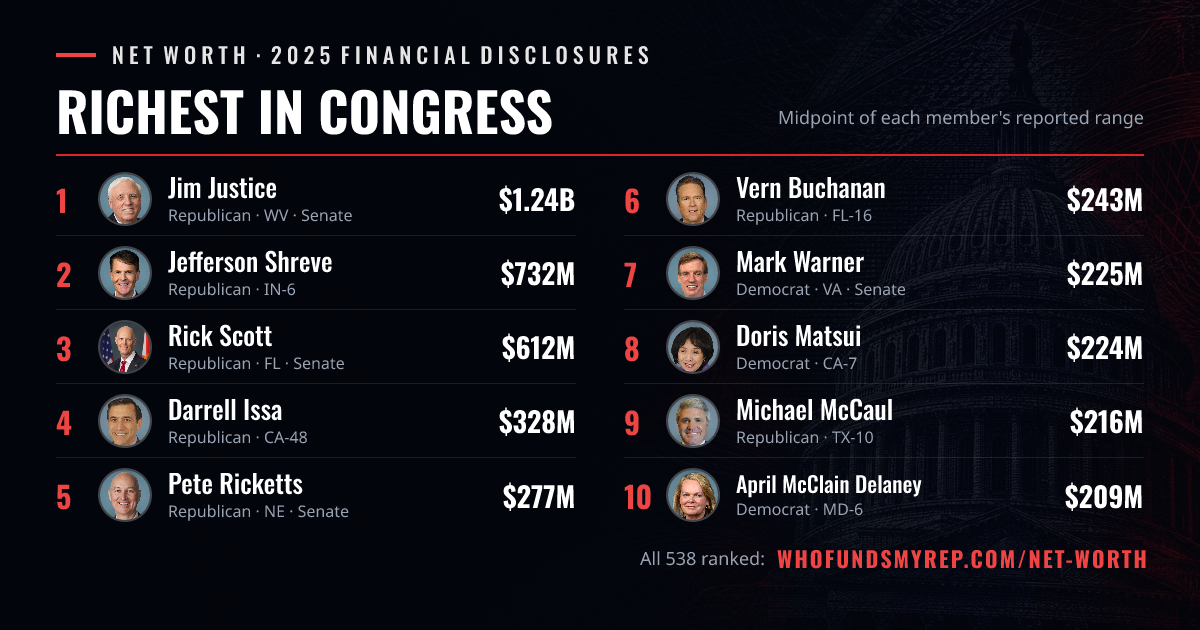
Jim Justice (Republican, WV (Senate)) is the wealthiest member of Congress on the 2025 disclosures at roughly $1.24B, between $820M and $1.66B.
538 filings parsed (32 transcribed from paper) · 329 with a midpoint over $1M · 41 below zero. Each figure is the midpoint of a range, so two members a few places apart may be in the opposite order in reality. How this is calculated.
Browse: All members · Democrats · Republicans · Senators · House members
All 538 members of Congress with a parsed filing, ranked by estimated net worth
- 1. Jim Justice net worth — Republican, WV (Senate) — $1.24B (between $820M and $1.66B)
- 2. Jefferson Shreve net worth — Republican, IN-06 — $732M (between $304M and $1.16B)
- 3. Rick Scott net worth — Republican, FL (Senate) — $612M (between $249M and $976M)
- 4. Darrell Issa net worth — Republican, CA-48 — $328M (between $136M and $520M)
- 5. Pete Ricketts net worth — Republican, NE (Senate) — $277M (between $128M and $426M)
- 6. Vern Buchanan net worth — Republican, FL-16 — $243M (between $106M and $381M)
- 7. Mark Warner net worth — Democrat, VA (Senate) — $225M (between $102M and $348M)
- 8. Doris Matsui net worth — Democrat, CA-07 — $224M (between $84M and $364M; from a paper filing)
- 9. Michael McCaul net worth — Republican, TX-10 — $216M (between $88M and $344M; from a paper filing)
- 10. April McClain Delaney net worth — Democrat, MD-06 — $209M (between $73M and $345M)
- 11. Dave McCormick net worth — Republican, PA (Senate) — $186M (between $63M and $309M)
- 12. Richard Blumenthal net worth — Democrat, CT (Senate) — $176M (between $76M and $275M; from a paper filing)
- 13. Dan Goldman net worth — Democrat, NY-10 — $172M (between $57M and $287M)
- 14. Alan Armstrong net worth — Republican, OK (Senate) — $171M (between $95M and $248M)
- 15. Tim Sheehy net worth — Republican, MT (Senate) — $157M (between $49M and $265M)
- 16. Nancy Pelosi net worth — Democrat, CA-11 — $142M (between −$67M and $351M)
- 17. Ro Khanna net worth — Democrat, CA-17 — $141M (between $69M and $212M; from a paper filing)
- 18. Suzan DelBene net worth — Democrat, WA-01 — $128M (between $50M and $206M)
- 19. Bernie Moreno net worth — Republican, OH (Senate) — $127M (between $37M and $217M)
- 20. Roger Williams net worth — Republican, TX-25 — $117M (between $63M and $170M)
- 21. Jay Obernolte net worth — Republican, CA-23 — $116M (between $47M and $184M)
- 22. Kevin Hern net worth — Republican, OK-01 — $111M (between $49M and $173M)
- 23. Scott Peters net worth — Democrat, CA-50 — $104M (between $43M and $165M)
- 24. Don Beyer net worth — Democrat, VA-08 — $89M (between $9.3M and $169M)
- 25. Sara Jacobs net worth — Democrat, CA-51 — $82M (between $23M and $140M)
- 26. Ron Johnson net worth — Republican, WI (Senate) — $79M (between $27M and $131M)
- 27. John Hoeven net worth — Republican, ND (Senate) — $69M (between $38M and $99M)
- 28. Gil Cisneros net worth — Democrat, CA-31 — $65M (between $10M and $120M)
- 29. Dan Meuser net worth — Republican, PA-09 — $64M (between $35M and $93M)
- 30. Cleo Fields net worth — Democrat, LA-06 — $59M (between $22M and $95M)
- 31. Lloyd Doggett net worth — Democrat, TX-37 — $58M (between $25M and $91M)
- 32. Bill Hagerty net worth — Republican, TN (Senate) — $58M (between $19M and $96M)
- 33. Ralph Norman net worth — Republican, SC-05 — $56M (between $21M and $92M)
- 34. Jim Risch net worth — Republican, ID (Senate) — $56M (between $19M and $92M)
- 35. John Rose net worth — Republican, TN-06 — $55M (between $20M and $89M)
- 36. Mitch McConnell net worth — Republican, KY (Senate) — $53M (between $22M and $84M)
- 37. Marlin Stutzman net worth — Republican, IN-03 — $50M (between $11M and $89M)
- 38. Diana Harshbarger net worth — Republican, TN-01 — $49M (between $20M and $77M; from a paper filing)
- 39. Ron Wyden net worth — Democrat, OR (Senate) — $47M (between $16M and $79M)
- 40. Kelly Morrison net worth — Democrat, MN-03 — $45M (between $20M and $70M)
- 41. Shri Thanedar net worth — Democrat, MI-13 — $44M (between −$7M and $95M)
- 42. John Hickenlooper net worth — Democrat, CO (Senate) — $42M (between $13M and $71M)
- 43. Carol Miller net worth — Republican, WV-01 — $42M (between −$24M and $107M)
- 44. George Whitesides net worth — Democrat, CA-27 — $40M (between $21M and $60M; from a paper filing)
- 45. Randy Fine net worth — Republican, FL-06 — $37M (between $13M and $61M)
- 46. Buddy Carter net worth — Republican, GA-01 — $36M (between $14M and $58M)
- 47. Josh Gottheimer net worth — Democrat, NJ-05 — $34M (between $10M and $58M)
- 48. Julie Johnson net worth — Democrat, TX-32 — $32M (between $9M and $54M)
- 49. Jim Baird net worth — Republican, IN-04 — $31M (between $11M and $51M)
- 50. John James net worth — Republican, MI-10 — $31M (between $11M and $51M)
- 51. Michael Bennet net worth — Democrat, CO (Senate) — $29M (between $11M and $47M)
- 52. Sheri Biggs net worth — Republican, SC-03 — $29M (between $13M and $45M)
- 53. Rob Bresnahan net worth — Republican, PA-08 — $28M (between $82K and $57M)
- 54. Brad Schneider net worth — Democrat, IL-10 — $27M (between $7M and $48M)
- 55. Michael Rulli net worth — Republican, OH-06 — $27M (between $9.1M and $44M)
- 56. Angus King net worth — Independent, ME (Senate) — $26M (between $9.5M and $42M)
- 57. Craig Goldman net worth — Republican, TX-12 — $25M (between $9.3M and $40M)
- 58. Vicente Gonzalez net worth — Democrat, TX-34 — $25M (between $10M and $39M; from a paper filing)
- 59. Rick Allen net worth — Republican, GA-12 — $23M (between $9.9M and $36M)
- 60. Sheldon Whitehouse net worth — Democrat, RI (Senate) — $23M (between $12M and $34M)
- 61. Ann Wagner net worth — Republican, MO-02 — $22M (between $8.1M and $37M)
- 62. Bob Onder net worth — Republican, MO-03 — $22M (between $8.1M and $35M)
- 63. Bill Foster net worth — Democrat, IL-11 — $22M (between $11M and $32M)
- 64. Victoria Spartz net worth — Republican, IN-05 — $21M (between $2.5M and $40M)
- 65. Brett Guthrie net worth — Republican, KY-02 — $21M (between $7.9M and $34M; from a paper filing)
- 66. Lori Trahan net worth — Democrat, MA-03 — $21M (between −$7.1M and $49M)
- 67. Steve Daines net worth — Republican, MT (Senate) — $21M (between $8.5M and $33M)
- 68. Mark Kelly net worth — Democrat, AZ (Senate) — $20M (between $7.6M and $33M)
- 69. Ryan Zinke net worth — Republican, MT-01 — $20M (between $3.3M and $38M)
- 70. John Joyce net worth — Republican, PA-13 — $20M (between $8.3M and $32M)
- 71. Dale Strong net worth — Republican, AL-05 — $20M (between $7.1M and $34M)
- 72. Kathy Castor net worth — Democrat, FL-14 — $20M (between $7.9M and $32M)
- 73. Kim Schrier net worth — Democrat, WA-08 — $20M (between $8M and $32M)
- 74. Nick Begich net worth — Republican, AK (House) — $20M (between $7.8M and $32M)
- 75. Andrew Clyde net worth — Republican, GA-09 — $20M (between $7M and $32M)
- 76. John Kennedy net worth — Republican, LA (Senate) — $19M (between $11M and $27M)
- 77. Jamie Raskin net worth — Democrat, MD-08 — $19M (between $9.6M and $28M)
- 78. French Hill net worth — Republican, AR-02 — $18M (between $10M and $26M)
- 79. Jacky Rosen net worth — Democrat, NV (Senate) — $18M (between $9.8M and $26M)
- 80. Chris Coons net worth — Democrat, DE (Senate) — $17M (between $5.2M and $29M)
- 81. Cory Mills net worth — Republican, FL-07 — $17M (between $6.1M and $27M)
- 82. Greg Murphy net worth — Republican, NC-03 — $17M (between $7.3M and $26M)
- 83. Pete Sessions net worth — Republican, TX-17 — $17M (between $9.1M and $24M)
- 84. Mike Collins net worth — Republican, GA-10 — $16M (between $4.9M and $27M)
- 85. Mary Miller net worth — Republican, IL-15 — $15M (between $4.9M and $26M)
- 86. Debbie Dingell net worth — Democrat, MI-06 — $15M (between $9.2M and $21M)
- 87. Troy Downing net worth — Republican, MT-02 — $15M (between $5.8M and $24M)
- 88. Dan Newhouse net worth — Republican, WA-04 — $15M (between $777K and $29M)
- 89. Mike Kelly net worth — Republican, PA-16 — $15M (between $3.4M and $26M)
- 90. Thomas Kean net worth — Republican, NJ-07 — $14M (between $7.4M and $21M)
- 91. Judy Chu net worth — Democrat, CA-28 — $14M (between $8M and $20M)
- 92. Jim Himes net worth — Democrat, CT-04 — $14M (between $6M and $21M)
- 93. Pat Fallon net worth — Republican, TX-04 — $13M (between $5.9M and $21M)
- 94. Katherine Clark net worth — Democrat, MA-05 — $13M (between $5.8M and $21M)
- 95. Peter Welch net worth — Democrat, VT (Senate) — $13M (between $6.9M and $19M)
- 96. Blake Moore net worth — Republican, UT-01 — $13M (between $3.8M and $22M)
- 97. Jeff Merkley net worth — Democrat, OR (Senate) — $12M (between $4.7M and $20M)
- 98. Jared Moskowitz net worth — Democrat, FL-23 — $12M (between $3.7M and $21M)
- 99. John Curtis net worth — Republican, UT (Senate) — $12M (between −$1.6M and $25M)
- 100. Ami Bera net worth — Democrat, CA-06 — $12M (between $5.5M and $18M)
- 101. Bob Latta net worth — Republican, OH-05 — $12M (between $6.3M and $17M)
- 102. Tracey Mann net worth — Republican, KS-01 — $11M (between $3M and $20M)
- 103. Laurel Lee net worth — Republican, FL-15 — $11M (between $5.3M and $18M)
- 104. Elizabeth Warren net worth — Democrat, MA (Senate) — $11M (between $4.4M and $18M)
- 105. Suzanne Bonamici net worth — Democrat, OR-01 — $11M (between $5.2M and $17M)
- 106. Lizzie Fletcher net worth — Democrat, TX-07 — $11M (between $4.7M and $17M)
- 107. Lisa Blunt Rochester net worth — Democrat, DE (Senate) — $11M (between $4.5M and $17M)
- 108. Tom Suozzi net worth — Democrat, NY-03 — $11M (between $4.8M and $17M)
- 109. Chuck Edwards net worth — Republican, NC-11 — $11M (between −$2.8M and $24M)
- 110. Steve Cohen net worth — Democrat, TN-09 — $11M (between $5.5M and $16M)
- 111. Michael Guest net worth — Republican, MS-03 — $10M (between $4.4M and $16M; from a paper filing)
- 112. Scott Franklin net worth — Republican, FL-18 — $10M (between $3.8M and $17M)
- 113. Tim Moore net worth — Republican, NC-14 — $10M (between $4.5M and $16M)
- 114. Mary Gay Scanlon net worth — Democrat, PA-05 — $10M (between $4.7M and $16M)
- 115. John Barrasso net worth — Republican, WY (Senate) — $10M (between $3.7M and $16M)
- 116. Seth Moulton net worth — Democrat, MA-06 — $9.7M (between −$1M and $20M)
- 117. Dusty Johnson net worth — Republican, SD (House) — $9.5M (between $6.1M and $13M)
- 118. Tom Cole net worth — Republican, OK-04 — $9.5M (between $5M and $14M)
- 119. Ted Cruz net worth — Republican, TX (Senate) — $9.4M (between $3.9M and $15M)
- 120. Tony Wied net worth — Republican, WI-08 — $9.3M (between $5.2M and $13M)
- 121. Maggie Goodlander net worth — Democrat, NH-02 — $9.2M (between $2.7M and $16M)
- 122. David Joyce net worth — Republican, OH-14 — $9M (between $4.8M and $13M)
- 123. Max Miller net worth — Republican, OH-07 — $9M (between $4.4M and $14M)
- 124. Jimmy Patronis net worth — Republican, FL-01 — $8.7M (between $3.9M and $14M)
- 125. Robert Aderholt net worth — Republican, AL-04 — $8.5M (between $4.1M and $13M)
- 126. David Kustoff net worth — Republican, TN-08 — $8.5M (between $4.1M and $13M)
- 127. Brad Knott net worth — Republican, NC-13 — $8.4M (between $3.3M and $13M)
- 128. Chuck Fleischmann net worth — Republican, TN-03 — $8.2M (between $4.5M and $12M; from a paper filing)
- 129. Gary Peters net worth — Democrat, MI (Senate) — $8.1M (between $4.3M and $12M)
- 130. Mike Rounds net worth — Republican, SD (Senate) — $8M (between $3.5M and $13M)
- 131. Dina Titus net worth — Democrat, NV-01 — $7.8M (between $3M and $13M; from a paper filing)
- 132. Juan Vargas net worth — Democrat, CA-52 — $7.8M (between $966K and $15M)
- 133. Jeanne Shaheen net worth — Democrat, NH (Senate) — $7.7M (between $4M and $11M)
- 134. Mazie Hirono net worth — Democrat, HI (Senate) — $7.6M (between $4.3M and $11M)
- 135. Julie Fedorchak net worth — Republican, ND (House) — $7.4M (between $3.5M and $11M)
- 136. Jake Auchincloss net worth — Democrat, MA-04 — $7.4M (between $3.5M and $11M)
- 137. Dan Sullivan net worth — Republican, AK (Senate) — $7.4M (between $3M and $12M)
- 138. Lucy McBath net worth — Democrat, GA-06 — $7.2M (between $2.3M and $12M)
- 139. Susan Collins net worth — Republican, ME (Senate) — $7.1M (between $4.2M and $10M)
- 140. Chellie Pingree net worth — Democrat, ME-01 — $7.1M (between $2.6M and $12M)
- 141. Sam Liccardo net worth — Democrat, CA-16 — $7.1M (between $1.5M and $13M)
- 142. Mike Haridopolos net worth — Republican, FL-08 — $7.1M (between $4.5M and $9.7M)
- 143. Angie Craig net worth — Democrat, MN-02 — $7M (between $4.5M and $9.5M; from a paper filing)
- 144. Lisa McClain net worth — Republican, MI-09 — $7M (between $3.4M and $11M)
- 145. Brad Finstad net worth — Republican, MN-01 — $7M (between $2.5M and $11M)
- 146. Ashley Moody net worth — Republican, FL (Senate) — $7M (between $2.9M and $11M)
- 147. Neal Dunn net worth — Republican, FL-02 — $6.7M (between $4.2M and $9.3M)
- 148. Thom Tillis net worth — Republican, NC (Senate) — $6.7M (between $3M and $10M)
- 149. Scott Fitzgerald net worth — Republican, WI-05 — $6.6M (between $1.9M and $11M)
- 150. Chuck Grassley net worth — Republican, IA (Senate) — $6.6M (between $4M and $9.1M)
- 151. Mike Flood net worth — Republican, NE-01 — $6.5M (between $1.6M and $11M)
- 152. Lou Correa net worth — Democrat, CA-46 — $6.5M (between $4.1M and $8.8M)
- 153. Deb Fischer net worth — Republican, NE (Senate) — $6.5M (between $1.9M and $11M)
- 154. Warren Davidson net worth — Republican, OH-08 — $6.4M (between $2.2M and $11M)
- 155. Shelley Moore Capito net worth — Republican, WV (Senate) — $6.4M (between $2.5M and $10M)
- 156. Ed Markey net worth — Democrat, MA (Senate) — $6.4M (between $3.1M and $9.6M)
- 157. Cliff Bentz net worth — Republican, OR-02 — $6.3M (between $3.4M and $9.1M)
- 158. Ed Case net worth — Democrat, HI-01 — $6.2M (between $3M and $9.4M)
- 159. Katie Britt net worth — Republican, AL (Senate) — $6.1M (between $1.9M and $10M)
- 160. Roger Marshall net worth — Republican, KS (Senate) — $6.1M (between $2.6M and $9.6M)
- 161. Paul Gosar net worth — Republican, AZ-09 — $6M (between $1.8M and $10M; from a paper filing)
- 162. Ted Budd net worth — Republican, NC (Senate) — $6M (between $2.3M and $9.7M)
- 163. Pat Harrigan net worth — Republican, NC-10 — $5.8M (between −$1.6M and $13M)
- 164. Donald Norcross net worth — Democrat, NJ-01 — $5.8M (between $2.6M and $9M)
- 165. Mike Thompson net worth — Democrat, CA-04 — $5.8M (between $3.8M and $7.8M; from a paper filing)
- 166. Al Green net worth — Democrat, TX-09 — $5.7M (between $2.7M and $8.8M)
- 167. James Comer net worth — Republican, KY-01 — $5.6M (between $2.8M and $8.4M)
- 168. Josh Harder net worth — Democrat, CA-09 — $5.6M (between $2.5M and $8.7M)
- 169. Maggie Hassan net worth — Democrat, NH (Senate) — $5.6M (between $3.1M and $8.1M)
- 170. Jake Ellzey net worth — Republican, TX-06 — $5.6M (between $2.2M and $9M)
- 171. Ashley Hinson net worth — Republican, IA-02 — $5.5M (between $2.3M and $8.8M)
- 172. Zoe Lofgren net worth — Democrat, CA-18 — $5.5M (between $2.3M and $8.7M)
- 173. Andy Harris net worth — Republican, MD-01 — $5.4M (between $2.5M and $8.3M)
- 174. Rudy Yakym net worth — Republican, IN-02 — $5.4M (between −$7.7M and $18M)
- 175. Andy Biggs net worth — Republican, AZ-05 — $5.3M (between $919K and $9.6M)
- 176. Brad Sherman net worth — Democrat, CA-32 — $5.2M (between $3.3M and $7.1M; from a paper filing)
- 177. Derek Schmidt net worth — Republican, KS-02 — $5.1M (between $2.7M and $7.6M)
- 178. Tina Smith net worth — Democrat, MN (Senate) — $5.1M (between $3.2M and $7M)
- 179. Julia Brownley net worth — Democrat, CA-26 — $4.9M (between $1.4M and $8.3M)
- 180. Chris Deluzio net worth — Democrat, PA-17 — $4.8M (between $2.6M and $7M)
- 181. Deborah Ross net worth — Democrat, NC-02 — $4.6M (between $1.8M and $7.4M)
- 182. Virginia Foxx net worth — Republican, NC-05 — $4.5M (between $2.8M and $6.3M)
- 183. Harriet Hageman net worth — Republican, WY (House) — $4.5M (between $2.1M and $6.9M)
- 184. Brandon Gill net worth — Republican, TX-26 — $4.4M (between $1.9M and $7M)
- 185. Rick Larsen net worth — Democrat, WA-02 — $4.4M (between $1.2M and $7.6M)
- 186. Catherine Cortez Masto net worth — Democrat, NV (Senate) — $4.4M (between $1.8M and $6.9M)
- 187. Susie Lee net worth — Democrat, NV-03 — $4.3M (between $2.2M and $6.5M)
- 188. Yassamin Ansari net worth — Democrat, AZ-03 — $4.3M (between $1.9M and $6.8M)
- 189. Mark Messmer net worth — Republican, IN-08 — $4.3M (between $2.5M and $6.1M)
- 190. Brian Babin net worth — Republican, TX-36 — $4.1M (between $2.3M and $6M)
- 191. Rob Wittman net worth — Republican, VA-01 — $4.1M (between $527K and $7.7M)
- 192. Joyce Beatty net worth — Democrat, OH-03 — $4.1M (between $1.6M and $6.6M)
- 193. Janelle Bynum net worth — Democrat, OR-05 — $4.1M (between $569K and $7.6M)
- 194. Mark Pocan net worth — Democrat, WI-02 — $4M (between $1.3M and $6.7M)
- 195. Sean Casten net worth — Democrat, IL-06 — $4M (between $2.5M and $5.5M)
- 196. Steny Hoyer net worth — Democrat, MD-05 — $3.9M (between $1.6M and $6.3M)
- 197. Frank Pallone net worth — Democrat, NJ-06 — $3.8M (between $1.8M and $5.9M)
- 198. Patty Murray net worth — Democrat, WA (Senate) — $3.8M (between $2.3M and $5.2M)
- 199. John Garamendi net worth — Democrat, CA-08 — $3.7M (between $1.1M and $6.3M)
- 200. Mike Crapo net worth — Republican, ID (Senate) — $3.7M (between $1.3M and $6.1M)
- 201. Ted Lieu net worth — Democrat, CA-36 — $3.6M (between $1.2M and $6.1M)
- 202. John Carter net worth — Republican, TX-31 — $3.6M (between $1.4M and $5.9M)
- 203. Sydney Kamlager-Dove net worth — Democrat, CA-37 — $3.6M (between $1.2M and $6M)
- 204. Raja Krishnamoorthi net worth — Democrat, IL-08 — $3.6M (between $1.8M and $5.3M)
- 205. Jim Costa net worth — Democrat, CA-21 — $3.6M (between $617K and $6.5M)
- 206. Analilia Mejia net worth — Democrat, NJ-11 — $3.5M (between $1.9M and $5M)
- 207. Diana DeGette net worth — Democrat, CO-01 — $3.5M (between $2.1M and $4.9M)
- 208. Pat Ryan net worth — Democrat, NY-18 — $3.5M (between $1.8M and $5.2M)
- 209. Jon Husted net worth — Republican, OH (Senate) — $3.5M (between $1.9M and $5M)
- 210. Bill Keating net worth — Democrat, MA-09 — $3.4M (between $1.8M and $5.1M)
- 211. Barry Moore net worth — Republican, AL-01 — $3.4M (between $1M and $5.9M)
- 212. Maria Cantwell net worth — Democrat, WA (Senate) — $3.4M (between $1.2M and $5.6M)
- 213. Maxine Dexter net worth — Democrat, OR-03 — $3.4M (between $2M and $4.7M)
- 214. Jon Ossoff net worth — Democrat, GA (Senate) — $3.4M (between $1.2M and $5.6M)
- 215. Rosa DeLauro net worth — Democrat, CT-03 — $3.3M (between $1.2M and $5.5M)
- 216. Bennie Thompson net worth — Democrat, MS-02 — $3.3M (between $2.1M and $4.5M)
- 217. Tommy Tuberville net worth — Republican, AL (Senate) — $3.3M (between $885K and $5.7M)
- 218. David Taylor net worth — Republican, OH-02 — $3.3M (between $1.6M and $5M)
- 219. Adam Gray net worth — Democrat, CA-13 — $3.2M (between $182K and $6.2M)
- 220. John Boozman net worth — Republican, AR (Senate) — $3.2M (between $1.2M and $5.2M)
- 221. Brian Schatz net worth — Democrat, HI (Senate) — $3.2M (between −$138K and $6.5M)
- 222. Amy Klobuchar net worth — Democrat, MN (Senate) — $3M (between $1.7M and $4.3M)
- 223. Glenn Grothman net worth — Republican, WI-06 — $3M (between $1.9M and $4.1M)
- 224. Jerry Moran net worth — Republican, KS (Senate) — $3M (between $1.6M and $4.4M)
- 225. Jonathan Jackson net worth — Democrat, IL-01 — $3M (between $1.3M and $4.6M)
- 226. Mark Harris net worth — Republican, NC-08 — $2.9M (between $503K and $5.3M)
- 227. Chrissy Houlahan net worth — Democrat, PA-06 — $2.9M (between $1.8M and $4M)
- 228. Frank Lucas net worth — Republican, OK-03 — $2.9M (between $1.7M and $4M)
- 229. Thomas Massie net worth — Republican, KY-04 — $2.9M (between $696K and $5M)
- 230. Ronny Jackson net worth — Republican, TX-13 — $2.9M (between $1.8M and $3.9M)
- 231. Chris Pappas net worth — Democrat, NH-01 — $2.8M (between −$392K and $6.1M)
- 232. Chuck Schumer net worth — Democrat, NY (Senate) — $2.8M (between $1.6M and $4.1M)
- 233. Carlos Giménez net worth — Republican, FL-28 — $2.8M (between $1.4M and $4.2M)
- 234. Nanette Barragán net worth — Democrat, CA-44 — $2.7M (between $224K and $5.3M)
- 235. Grace Meng net worth — Democrat, NY-06 — $2.7M (between $1.1M and $4.4M)
- 236. Josh Riley net worth — Democrat, NY-19 — $2.7M (between $1.7M and $3.8M)
- 237. Lisa Murkowski net worth — Republican, AK (Senate) — $2.7M (between $1.5M and $3.9M)
- 238. Young Kim net worth — Republican, CA-40 — $2.7M (between $552K and $4.9M)
- 239. Jim Banks net worth — Republican, IN (Senate) — $2.7M (between −$13K and $5.5M)
- 240. Gary Palmer net worth — Republican, AL-06 — $2.7M (between $1.6M and $3.7M)
- 241. Jim McGovern net worth — Democrat, MA-02 — $2.7M (between $115K and $5.2M)
- 242. Lois Frankel net worth — Democrat, FL-22 — $2.6M (between $1.4M and $3.8M)
- 243. Cory Booker net worth — Democrat, NJ (Senate) — $2.6M (between $1.5M and $3.7M)
- 244. Dick Durbin net worth — Democrat, IL (Senate) — $2.6M (between $2.6M and $2.6M; from a paper filing)
- 245. Maxine Waters net worth — Democrat, CA-43 — $2.6M (between −$139K and $5.3M)
- 246. John Larson net worth — Democrat, CT-01 — $2.6M (between $1.5M and $3.6M)
- 247. Frederica Wilson net worth — Democrat, FL-24 — $2.5M (between $1.6M and $3.4M)
- 248. Greg Stanton net worth — Democrat, AZ-04 — $2.5M (between $1.4M and $3.6M)
- 249. Eleanor Holmes Norton net worth — Democrat, DC (House) — $2.5M (between $1.5M and $3.5M)
- 250. Vince Fong net worth — Republican, CA-20 — $2.5M (between $1.2M and $3.8M)
- 251. Brian Fitzpatrick net worth — Republican, PA-01 — $2.5M (between $301K and $4.7M)
- 252. Mike Levin net worth — Democrat, CA-49 — $2.5M (between $1.6M and $3.3M)
- 253. Mike Simpson net worth — Republican, ID-02 — $2.4M (between $1.6M and $3.3M)
- 254. Greg Landsman net worth — Democrat, OH-01 — $2.3M (between $1.1M and $3.6M)
- 255. Jennifer McClellan net worth — Democrat, VA-04 — $2.3M (between $984K and $3.6M)
- 256. Clay Fuller net worth — Republican, GA-14 — $2.3M (between $1.2M and $3.4M)
- 257. Marilyn Strickland net worth — Democrat, WA-10 — $2.3M (between $1.2M and $3.4M)
- 258. Luz Rivas net worth — Democrat, CA-29 — $2.3M (between $1,004 and $4.6M)
- 259. Rand Paul net worth — Republican, KY (Senate) — $2.3M (between $1.2M and $3.3M)
- 260. Alex Padilla net worth — Democrat, CA (Senate) — $2.3M (between −$35K and $4.5M)
- 261. Suhas Subramanyam net worth — Democrat, VA-10 — $2.2M (between $1.4M and $3M)
- 262. Tim Kaine net worth — Democrat, VA (Senate) — $2.1M (between $1.1M and $3.2M)
- 263. Josh Hawley net worth — Republican, MO (Senate) — $2.1M (between $489K and $3.8M)
- 264. María Elvira Salazar net worth — Republican, FL-27 — $2.1M (between $1.1M and $3.1M)
- 265. Kristen McDonald Rivet net worth — Democrat, MI-08 — $2.1M (between $1.2M and $3M)
- 266. Nicole Malliotakis net worth — Republican, NY-11 — $2.1M (between $1.1M and $3.1M)
- 267. Becca Balint net worth — Democrat, VT (House) — $2M (between $937K and $3.2M)
- 268. Nellie Pou net worth — Democrat, NJ-09 — $2M (between $1.2M and $2.9M)
- 269. Adam Schiff net worth — Democrat, CA (Senate) — $2M (between $1.1M and $2.9M)
- 270. Bryan Steil net worth — Republican, WI-01 — $2M (between $1.2M and $2.8M)
- 271. James Moylan net worth — Republican, GU (House) — $1.9M (between $981K and $2.9M)
- 272. Byron Donalds net worth — Republican, FL-19 — $1.9M (between $691K and $3.1M)
- 273. Andy Barr net worth — Republican, KY-06 — $1.9M (between $956K and $2.8M)
- 274. Teresa Leger Fernández net worth — Democrat, NM-03 — $1.9M (between $1.1M and $2.6M)
- 275. Mike Carey net worth — Republican, OH-15 — $1.8M (between $944K and $2.7M)
- 276. Lloyd Smucker net worth — Republican, PA-11 — $1.8M (between −$682K and $4.3M)
- 277. Joe Courtney net worth — Democrat, CT-02 — $1.8M (between $806K and $2.8M)
- 278. Christian Menefee net worth — Democrat, TX-18 — $1.8M (between $911K and $2.7M)
- 279. Andy Kim net worth — Democrat, NJ (Senate) — $1.8M (between $1M and $2.6M)
- 280. Keith Self net worth — Republican, TX-03 — $1.8M (between $1.1M and $2.5M; from a paper filing)
- 281. John Cornyn net worth — Republican, TX (Senate) — $1.8M (between $992K and $2.6M)
- 282. Bill Huizenga net worth — Republican, MI-04 — $1.8M (between $839K and $2.7M)
- 283. Mariannette Miller-Meeks net worth — Republican, IA-01 — $1.8M (between $886K and $2.7M)
- 284. Stephanie Bice net worth — Republican, OK-05 — $1.7M (between $880K and $2.6M)
- 285. Glenn Ivey net worth — Democrat, MD-04 — $1.7M (between $788K and $2.6M)
- 286. Jeff Crank net worth — Republican, CO-05 — $1.7M (between $453K and $3M)
- 287. Morgan McGarvey net worth — Democrat, KY-03 — $1.7M (between $767K and $2.6M)
- 288. Michael Baumgartner net worth — Republican, WA-05 — $1.7M (between $1M and $2.3M)
- 289. Don Bacon net worth — Republican, NE-02 — $1.7M (between $261K and $3M)
- 290. Marsha Blackburn net worth — Republican, TN (Senate) — $1.6M (between $831K and $2.4M)
- 291. Julia Letlow net worth — Republican, LA-05 — $1.6M (between $338K and $2.9M)
- 292. Pramila Jayapal net worth — Democrat, WA-07 — $1.6M (between $872K and $2.4M)
- 293. Tim Scott net worth — Republican, SC (Senate) — $1.6M (between −$316K and $3.5M)
- 294. Erin Houchin net worth — Republican, IN-09 — $1.6M (between $851K and $2.2M)
- 295. Jeff Van Drew net worth — Republican, NJ-02 — $1.5M (between $967K and $2.1M; from a paper filing)
- 296. Mike Kennedy net worth — Republican, UT-03 — $1.5M (between $854K and $2.2M)
- 297. Tammy Duckworth net worth — Democrat, IL (Senate) — $1.5M (between $524K and $2.5M)
- 298. Raphael Warnock net worth — Democrat, GA (Senate) — $1.5M (between $884K and $2.1M)
- 299. Laura Friedman net worth — Democrat, CA-30 — $1.5M (between $713K and $2.2M)
- 300. Scott Perry net worth — Republican, PA-10 — $1.5M (between $447K and $2.5M)
- 301. Eli Crane net worth — Republican, AZ-02 — $1.4M (between $882K and $2M)
- 302. John Fetterman net worth — Democrat, PA (Senate) — $1.4M (between $547K and $2.3M)
- 303. Austin Scott net worth — Republican, GA-08 — $1.4M (between $631K and $2.2M)
- 304. Raul Ruiz net worth — Democrat, CA-25 — $1.3M (between $671K and $2M)
- 305. Claudia Tenney net worth — Republican, NY-24 — $1.3M (between $659K and $2M)
- 306. Dave Min net worth — Democrat, CA-47 — $1.3M (between −$151K and $2.8M)
- 307. Daniel Webster net worth — Republican, FL-11 — $1.3M (between $751K and $1.8M)
- 308. Rob Menendez net worth — Democrat, NJ-08 — $1.3M (between $450K and $2.1M)
- 309. Madeleine Dean net worth — Democrat, PA-04 — $1.3M (between −$87K and $2.6M)
- 310. Chip Roy net worth — Republican, TX-21 — $1.3M (between $535K and $2M)
- 311. Bernie Sanders net worth — Independent, VT (Senate) — $1.2M (between $662K and $1.8M)
- 312. Ryan Mackenzie net worth — Republican, PA-07 — $1.2M (between $735K and $1.7M)
- 313. August Pfluger net worth — Republican, TX-11 — $1.2M (between $50K and $2.4M)
- 314. Rich McCormick net worth — Republican, GA-07 — $1.2M (between $473K and $1.9M)
- 315. Brian Jack net worth — Republican, GA-03 — $1.2M (between $586K and $1.8M)
- 316. Seth Magaziner net worth — Democrat, RI-02 — $1.2M (between $657K and $1.7M)
- 317. Brendan Boyle net worth — Democrat, PA-02 — $1.1M (between $515K and $1.7M)
- 318. Eric Schmitt net worth — Republican, MO (Senate) — $1.1M (between $594K and $1.6M)
- 319. Aaron Bean net worth — Republican, FL-04 — $1.1M (between $127K and $2.1M)
- 320. Jared Huffman net worth — Democrat, CA-02 — $1.1M (between $135K and $2.1M)
- 321. Kweisi Mfume net worth — Democrat, MD-07 — $1.1M (between $700K and $1.5M)
- 322. Nikki Budzinski net worth — Democrat, IL-13 — $1.1M (between $479K and $1.7M)
- 323. Dwight Evans net worth — Democrat, PA-03 — $1.1M (between $388K and $1.8M)
- 324. Bruce Westerman net worth — Republican, AR-04 — $1.1M (between $537K and $1.6M)
- 325. Johnny Olszewski net worth — Democrat, MD-02 — $1.1M (between $483K and $1.6M)
- 326. Bobby Scott net worth — Democrat, VA-03 — $1.1M (between $375K and $1.7M)
- 327. Sylvia Garcia net worth — Democrat, TX-29 — $1M (between $438K and $1.6M)
- 328. Marcy Kaptur net worth — Democrat, OH-09 — $1M (between $567K and $1.5M)
- 329. Jack Bergman net worth — Republican, MI-01 — $1M (between $647K and $1.4M)
- 330. Kevin Cramer net worth — Republican, ND (Senate) — $999K (between $653K and $1.3M)
- 331. Ben Cline net worth — Republican, VA-06 — $993K (between $574K and $1.4M)
- 332. Laura Gillen net worth — Democrat, NY-04 — $991K (between $522K and $1.5M)
- 333. David Rouzer net worth — Republican, NC-07 — $946K (between $441K and $1.4M)
- 334. John Rutherford net worth — Republican, FL-05 — $943K (between $402K and $1.5M)
- 335. Jill Tokuda net worth — Democrat, HI-02 — $936K (between $448K and $1.4M)
- 336. Tammy Baldwin net worth — Democrat, WI (Senate) — $933K (between $601K and $1.3M)
- 337. Cindy Hyde-Smith net worth — Republican, MS (Senate) — $932K (between $194K and $1.7M)
- 338. Hal Rogers net worth — Republican, KY-05 — $900K (between $730K and $1.1M; from a paper filing)
- 339. James Walkinshaw net worth — Democrat, VA-11 — $883K (between $565K and $1.2M)
- 340. Ron Estes net worth — Republican, KS-04 — $876K (between $385K and $1.4M)
- 341. Val Hoyle net worth — Democrat, OR-04 — $875K (between $348K and $1.4M)
- 342. Joni Ernst net worth — Republican, IA (Senate) — $865K (between $355K and $1.4M)
- 343. Jason Smith net worth — Republican, MO-08 — $837K (between −$417K and $2.1M)
- 344. Pablo Jose Hernández net worth — Democrat, PR (House) — $833K (between $211K and $1.5M)
- 345. Andrea Salinas net worth — Democrat, OR-06 — $828K (between $405K and $1.3M)
- 346. Darren Soto net worth — Democrat, FL-09 — $826K (between $201K and $1.4M)
- 347. Matt Van Epps net worth — Republican, TN-07 — $817K (between −$149K and $1.8M)
- 348. John McGuire net worth — Republican, VA-05 — $806K (between −$315K and $1.9M)
- 349. Jen Kiggans net worth — Republican, VA-02 — $781K (between −$4.4M and $5.9M)
- 350. Derek Tran net worth — Democrat, CA-45 — $778K (between −$4.4M and $6M)
- 351. Riley Moore net worth — Republican, WV-02 — $774K (between $467K and $1.1M)
- 352. Kirsten Gillibrand net worth — Democrat, NY (Senate) — $758K (between $465K and $1.1M)
- 353. Jeff Hurd net worth — Republican, CO-03 — $755K (between $449K and $1.1M)
- 354. Lance Gooden net worth — Republican, TX-05 — $746K (between $357K and $1.1M)
- 355. Terri Sewell net worth — Democrat, AL-07 — $736K (between $385K and $1.1M)
- 356. Pete Stauber net worth — Republican, MN-08 — $722K (between −$166K and $1.6M)
- 357. Nathaniel Moran net worth — Republican, TX-01 — $720K (between $289K and $1.1M)
- 358. John Thune net worth — Republican, SD (Senate) — $706K (between $330K and $1.1M)
- 359. John Moolenaar net worth — Republican, MI-02 — $699K (between $391K and $1M)
- 360. Henry Cuellar net worth — Democrat, TX-28 — $699K (between $48K and $1.3M)
- 361. David Schweikert net worth — Republican, AZ-01 — $697K (between $364K and $1M)
- 362. Tom Cotton net worth — Republican, AR (Senate) — $694K (between $368K and $1M)
- 363. Gabe Evans net worth — Republican, CO-08 — $679K (between $363K and $995K)
- 364. LaMonica McIver net worth — Democrat, NJ-10 — $661K (between $216K and $1.1M)
- 365. Joseph Morelle net worth — Democrat, NY-25 — $651K (between $339K and $963K)
- 366. Wesley Hunt net worth — Republican, TX-38 — $636K (between $287K and $985K)
- 367. Tim Walberg net worth — Republican, MI-05 — $635K (between $295K and $975K)
- 368. Zach Nunn net worth — Republican, IA-03 — $624K (between −$130K and $1.4M)
- 369. Michael Cloud net worth — Republican, TX-27 — $616K (between $316K and $915K)
- 370. Martin Heinrich net worth — Democrat, NM (Senate) — $614K (between $336K and $892K)
- 371. Adam Smith net worth — Democrat, WA-09 — $607K (between $334K and $879K)
- 372. Delia Ramirez net worth — Democrat, IL-03 — $591K (between $202K and $980K)
- 373. Hakeem Jeffries net worth — Democrat, NY-08 — $589K (between $175K and $1M)
- 374. Greg Steube net worth — Republican, FL-17 — $589K (between $11K and $1.2M)
- 375. Morgan Luttrell net worth — Republican, TX-08 — $580K (between $104K and $1.1M)
- 376. Randy Weber net worth — Republican, TX-14 — $580K (between −$401K and $1.6M)
- 377. Scott DesJarlais net worth — Republican, TN-04 — $577K (between $311K and $842K)
- 378. Danny Davis net worth — Democrat, IL-07 — $577K (between $353K and $800K; from a paper filing)
- 379. Jim Jordan net worth — Republican, OH-04 — $552K (between $258K and $846K)
- 380. Brian Mast net worth — Republican, FL-21 — $551K (between $100K and $1M)
- 381. Juan Ciscomani net worth — Republican, AZ-06 — $549K (between $304K and $794K)
- 382. Stephen Lynch net worth — Democrat, MA-08 — $541K (between −$199K and $1.3M)
- 383. Jimmy Panetta net worth — Democrat, CA-19 — $540K (between $230K and $850K)
- 384. Elissa Slotkin net worth — Democrat, MI (Senate) — $499K (between $317K and $681K)
- 385. Joe Wilson net worth — Republican, SC-02 — $485K (between −$450K and $1.4M)
- 386. Tom Barrett net worth — Republican, MI-07 — $471K (between $143K and $798K)
- 387. Veronica Escobar net worth — Democrat, TX-16 — $469K (between $152K and $785K)
- 388. Darin LaHood net worth — Republican, IL-16 — $464K (between $167K and $761K)
- 389. Mark DeSaulnier net worth — Democrat, CA-10 — $458K (between $301K and $615K)
- 390. Cynthia Lummis net worth — Republican, WY (Senate) — $431K (between −$19M and $20M)
- 391. Mark Alford net worth — Republican, MO-04 — $425K (between $29K and $820K)
- 392. Mike Lee net worth — Republican, UT (Senate) — $415K (between $230K and $600K)
- 393. Yvette Clarke net worth — Democrat, NY-09 — $415K (between $230K and $600K)
- 394. Alma Adams net worth — Democrat, NC-12 — $408K (between $265K and $550K)
- 395. Emilia Sykes net worth — Democrat, OH-13 — $407K (between $7,011 and $806K)
- 396. Mark Takano net worth — Democrat, CA-39 — $406K (between $232K and $580K)
- 397. Trent Kelly net worth — Republican, MS-01 — $401K (between $166K and $635K)
- 398. Tim Kennedy net worth — Democrat, NY-26 — $399K (between $207K and $590K)
- 399. Frank Mrvan net worth — Democrat, IN-01 — $398K (between $206K and $590K)
- 400. Mike Bost net worth — Republican, IL-12 — $396K (between $49K and $742K)
- 401. Guy Reschenthaler net worth — Republican, PA-14 — $392K (between $230K and $553K)
- 402. Chris Smith net worth — Republican, NJ-04 — $383K (between $215K and $550K)
- 403. Nick LaLota net worth — Republican, NY-01 — $370K (between $179K and $560K)
- 404. Richard Neal net worth — Democrat, MA-01 — $359K (between $201K and $517K)
- 405. Russ Fulcher net worth — Republican, ID-01 — $357K (between $218K and $495K)
- 406. Nancy Mace net worth — Republican, SC-01 — $353K (between $191K and $515K)
- 407. Nick Langworthy net worth — Republican, NY-23 — $347K (between $173K and $521K)
- 408. Jim Clyburn net worth — Democrat, SC-06 — $332K (between $182K and $481K)
- 409. Jan Schakowsky net worth — Democrat, IL-09 — $328K (between −$40K and $695K)
- 410. Elise Stefanik net worth — Republican, NY-21 — $307K (between $19K and $595K; from a paper filing)
- 411. Haley Stevens net worth — Democrat, MI-11 — $307K (between $136K and $477K)
- 412. James Gallagher net worth — Republican, CA-01 — $298K (between $65K and $530K)
- 413. Mike Lawler net worth — Republican, NY-17 — $279K (between $113K and $445K)
- 414. Jason Crow net worth — Democrat, CO-06 — $272K (between $118K and $425K)
- 415. Troy Nehls net worth — Republican, TX-22 — $259K (between $87K and $430K)
- 416. Glenn Thompson net worth — Republican, PA-15 — $258K (between $151K and $365K)
- 417. Anna Paulina Luna net worth — Republican, FL-13 — $251K (between −$100K and $602K)
- 418. Ritchie Torres net worth — Democrat, NY-15 — $249K (between $131K and $366K)
- 419. Kat Cammack net worth — Republican, FL-03 — $244K (between −$219K and $707K)
- 420. James Lankford net worth — Republican, OK (Senate) — $242K (between −$201K and $685K)
- 421. Troy Carter net worth — Democrat, LA-02 — $242K (between −$433K and $916K; from a paper filing)
- 422. Mark Amodei net worth — Republican, NV-02 — $241K (between $16K and $465K)
- 423. John Mannion net worth — Democrat, NY-22 — $239K (between −$88K and $565K)
- 424. Jack Reed net worth — Democrat, RI (Senate) — $232K (between $69K and $394K)
- 425. Jimmy Gomez net worth — Democrat, CA-34 — $229K (between −$183K and $640K)
- 426. Robert Garcia net worth — Democrat, CA-42 — $226K (between $101K and $350K)
- 427. Abraham Hamadeh net worth — Republican, AZ-08 — $225K (between −$247K and $696K)
- 428. Tom Tiffany net worth — Republican, WI-07 — $215K (between $119K and $311K)
- 429. Bill Cassidy net worth — Republican, LA (Senate) — $212K (between $104K and $319K)
- 430. Beth Van Duyne net worth — Republican, TX-24 — $210K (between $70K and $350K)
- 431. Pete Aguilar net worth — Democrat, CA-33 — $210K (between $70K and $350K)
- 432. Josh Brecheen net worth — Republican, OK-02 — $208K (between $115K and $300K)
- 433. Troy Balderson net worth — Republican, OH-12 — $208K (between −$35K and $450K)
- 434. Valerie Foushee net worth — Democrat, NC-04 — $208K (between $115K and $300K)
- 435. Ayanna Pressley net worth — Democrat, MA-07 — $201K (between −$5M and $5.4M)
- 436. Richard Hudson net worth — Republican, NC-09 — $200K (between $39K and $361K)
- 437. Ben Ray Luján net worth — Democrat, NM (Senate) — $195K (between $89K and $300K)
- 438. Amata Coleman Radewagen net worth — Republican, AS (House) — $193K (between $46K and $340K)
- 439. Michelle Fischbach net worth — Republican, MN-07 — $192K (between −$397K and $780K)
- 440. Chris Van Hollen net worth — Democrat, MD (Senate) — $183K (between $115K and $250K)
- 441. Rashida Tlaib net worth — Democrat, MI-12 — $179K (between −$494K and $852K)
- 442. Bonnie Watson Coleman net worth — Democrat, NJ-12 — $175K (between $100K and $250K; from a paper filing)
- 443. Melanie Stansbury net worth — Democrat, NM-01 — $175K (between $100K and $250K)
- 444. Jared Golden net worth — Democrat, ME-02 — $172K (between $38K and $306K)
- 445. Darline Graham net worth — Republican, SC (Senate) — $172K (between $84K and $260K)
- 446. Ruben Gallego net worth — Democrat, AZ (Senate) — $168K (between $35K and $300K)
- 447. Monica De La Cruz net worth — Republican, TX-15 — $164K (between −$542K and $870K)
- 448. Hillary Scholten net worth — Democrat, MI-03 — $160K (between $20K and $300K)
- 449. Randy Feenstra net worth — Republican, IA-04 — $154K (between $63K and $245K)
- 450. Andrew Garbarino net worth — Republican, NY-02 — $147K (between −$9,984 and $303K)
- 451. Jodey Arrington net worth — Republican, TX-19 — $135K (between −$788K and $1.1M)
- 452. Eric Burlison net worth — Republican, MO-07 — $134K (between −$592K and $860K)
- 453. Marc Veasey net worth — Democrat, TX-33 — $129K (between −$7,986 and $265K)
- 454. Mario Díaz-Balart net worth — Republican, FL-26 — $124K (between $56K and $191K)
- 455. Andy Ogles net worth — Republican, TN-05 — $123K (between −$319K and $565K)
- 456. Steven Horsford net worth — Democrat, NV-04 — $98K (between $45K and $150K)
- 457. Gabe Amo net worth — Democrat, RI-01 — $97K (between $23K and $171K)
- 458. Mike Turner net worth — Republican, OH-10 — $97K (between −$397K and $590K)
- 459. Derrick Van Orden net worth — Republican, WI-03 — $87K (between $38K and $135K)
- 460. Eric Sorensen net worth — Democrat, IL-17 — $83K (between $51K and $115K)
- 461. Adelita Grijalva net worth — Democrat, AZ-07 — $82K (between $32K and $131K)
- 462. Emily Randall net worth — Democrat, WA-06 — $81K (between $32K and $130K)
- 463. Sarah Elfreth net worth — Democrat, MD-03 — $74K (between −$3,995 and $151K)
- 464. Lauren Underwood net worth — Democrat, IL-14 — $67K (between $19K and $115K)
- 465. Everton Blair net worth — Democrat, GA-13 — $65K (between −$220K and $350K)
- 466. Sam Graves net worth — Republican, MO-06 — $59K (between −$4.7M and $4.8M)
- 467. Barry Loudermilk net worth — Republican, GA-11 — $41K (between $16K and $66K)
- 468. Don Davis net worth — Democrat, NC-01 — $41K (between $16K and $65K)
- 469. Robin Kelly net worth — Democrat, IL-02 — $41K (between $16K and $65K)
- 470. Adriano Espaillat net worth — Democrat, NY-13 — $33K (between −$284K and $350K)
- 471. André Carson net worth — Democrat, IN-07 — $33K (between $15K and $50K)
- 472. Greg Casar net worth — Democrat, TX-35 — $33K (between −$20K and $85K)
- 473. Hank Johnson net worth — Democrat, GA-04 — $33K (between $15K and $50K)
- 474. Paul Tonko net worth — Democrat, NY-20 — $33K (between $15K and $50K)
- 475. Sarah McBride net worth — Democrat, DE (House) — $33K (between $15K and $50K)
- 476. Tom Emmer net worth — Republican, MN-06 — $33K (between $15K and $50K; from a paper filing)
- 477. Gabe Vasquez net worth — Democrat, NM-02 — $32K (between $4,004 and $60K)
- 478. Joe Neguse net worth — Democrat, CO-02 — $30K (between −$515K and $575K)
- 479. Shontel Brown net worth — Democrat, OH-11 — $25K (between $3,004 and $47K)
- 480. Nydia Velázquez net worth — Democrat, NY-07 — $25K (between −$500K and $550K)
- 481. Celeste Maloy net worth — Republican, UT-02 — $24K (between $3,003 and $45K)
- 482. Alexandria Ocasio-Cortez net worth — Democrat, NY-14 — $17K (between −$33K and $66K)
- 483. Todd Young net worth — Republican, IN (Senate) — $17K (between $2,002 and $31K)
- 484. Mike Ezell net worth — Republican, MS-04 — $16K (between $2,002 and $30K)
- 485. Jerry Nadler net worth — Democrat, NY-12 — $12K (between −$12K and $35K; from a paper filing)
- 486. George Latimer net worth — Democrat, NY-16 — $10K (between −$374K and $394K)
- 487. Ilhan Omar net worth — Democrat, MN-05 — $8,502 (between −$80K and $97K)
- 488. Morgan Griffith net worth — Republican, VA-09 — $3,501 (between −$498K and $505K)
- 489. Joaquin Castro net worth — Democrat, TX-20 — $3,501 (between −$13K and $20K; from a paper filing)
- 490. Aisha Wahab net worth — Democrat, CA-14 — $0 (between $0 and $0; from a paper filing)
- 491. Clay Higgins net worth — Republican, LA-03 — $0 (between $0 and $0)
- 492. David Valadao net worth — Republican, CA-22 — $0 (between $0 and $0)
- 493. Rick Crawford net worth — Republican, AR-01 — $0 (between $0 and $0)
- 494. Gregory Meeks net worth — Democrat, NY-05 — $0 (between $0 and $0)
- 495. Gwen Moore net worth — Democrat, WI-04 — $0 (between $0 and $0; from a paper filing)
- 496. Chuy García net worth — Democrat, IL-04 — $0 (between $0 and $0)
- 497. Maxwell Frost net worth — Democrat, FL-10 — $0 (between $0 and $0)
- 498. Lateefah Simon net worth — Democrat, CA-12 — −$1,497 (between −$73K and $70K)
- 499. Jasmine Crockett net worth — Democrat, TX-30 — −$8,499 (between −$47K and $30K)
- 500. Lauren Boebert net worth — Republican, CO-04 — −$13K (between −$15K and −$10K)
- 501. Sharice Davids net worth — Democrat, KS-03 — −$26K (between −$393K and $340K)
- 502. Mike Johnson net worth — Republican, LA-04 — −$33K (between −$50K and −$15K)
- 503. Steve Scalise net worth — Republican, LA-01 — −$33K (between −$50K and −$15K)
- 504. Tim Burchett net worth — Republican, TN-02 — −$36K (between −$64K and −$7,001)
- 505. Norma Torres net worth — Democrat, CA-35 — −$59K (between −$184K and $65K)
- 506. Nikema Williams net worth — Democrat, GA-05 — −$60K (between −$195K and $75K)
- 507. Mike Rogers net worth — Republican, AL-03 — −$63K (between −$720K and $593K; from a paper filing)
- 508. Mike Quigley net worth — Democrat, IL-05 — −$65K (between −$135K and $4,997; from a paper filing)
- 509. Tom McClintock net worth — Republican, CA-05 — −$67K (between −$134K and −$2)
- 510. Kevin Mullin net worth — Democrat, CA-15 — −$91K (between −$1M and $837K)
- 511. Sanford Bishop net worth — Democrat, GA-02 — −$92K (between −$283K and $100K)
- 512. Kevin Kiley net worth — Independent, CA-03 — −$118K (between −$232K and −$5,001)
- 513. Linda Sánchez net worth — Democrat, CA-38 — −$134K (between −$1.2M and $976K)
- 514. Roger Wicker net worth — Republican, MS (Senate) — −$139K (between −$783K and $505K)
- 515. Wesley Bell net worth — Democrat, MO-01 — −$143K (between −$235K and −$50K)
- 516. Eugene Vindman net worth — Democrat, VA-07 — −$164K (between −$1.2M and $855K)
- 517. Burgess Owens net worth — Republican, UT-04 — −$174K (between −$250K and −$97K; from a paper filing)
- 518. Stacey Plaskett net worth — Democrat, VI (House) — −$175K (between −$250K and −$100K)
- 519. Addison McDowell net worth — Republican, NC-06 — −$180K (between −$264K and −$95K)
- 520. Salud Carbajal net worth — Democrat, CA-24 — −$194K (between −$968K and $580K)
- 521. Marie Gluesenkamp Perez net worth — Democrat, WA-03 — −$202K (between −$905K and $500K)
- 522. Brittany Pettersen net worth — Democrat, CO-07 — −$225K (between −$938K and $487K)
- 523. Herb Conaway net worth — Democrat, NJ-03 — −$239K (between −$683K and $205K)
- 524. Angela Alsobrooks net worth — Democrat, MD (Senate) — −$367K (between −$649K and −$84K)
- 525. Summer Lee net worth — Democrat, PA-12 — −$408K (between −$550K and −$265K)
- 526. Debbie Wasserman Schultz net worth — Democrat, FL-25 — −$522K (between −$1.1M and $53K)
- 527. Russell Fry net worth — Republican, SC-07 — −$526K (between −$793K and −$260K)
- 528. Betty McCollum net worth — Democrat, MN-04 — −$550K (between −$750K and −$350K)
- 529. Kimberlyn King-Hinds net worth — Republican, MP (House) — −$558K (between −$800K and −$315K)
- 530. Jahana Hayes net worth — Democrat, CT-05 — −$563K (between −$915K and −$210K)
- 531. Steve Womack net worth — Republican, AR-03 — −$572K (between −$1.1M and −$85K)
- 532. Gus Bilirakis net worth — Republican, FL-12 — −$593K (between −$1.1M and −$130K; from a paper filing)
- 533. Adrian Smith net worth — Republican, NE-03 — −$2.1M (between −$5.2M and $1M)
- 534. Emanuel Cleaver net worth — Democrat, MO-05 — −$2.3M (between −$4.6M and −$66K)
- 535. Chris Murphy net worth — Democrat, CT (Senate) — −$2.5M (between −$4.9M and −$5,002)
- 536. Shomari Figures net worth — Democrat, AL-02 — −$2.6M (between −$5.1M and −$150K)
- 537. William Timmons net worth — Republican, SC-04 — −$3.3M (between −$10M and $3.6M)
- 538. Ken Calvert net worth — Republican, CA-41 — −$38M (between −$93M and $16M)
Frequently asked
- Who is the richest member of Congress?
- By the midpoint of the range in the 2025 financial disclosures processed so far, Jim Justice (Republican, WV (Senate)) is the wealthiest member of Congress at roughly $1.24B, between $820M and $1.66B. Next are Jefferson Shreve (~$732M), Rick Scott (~$612M), Darrell Issa (~$328M).
- How many members of Congress are millionaires?
- 329 of the 538 members whose 2025 disclosures have been parsed have an estimated net worth above $1 million at the midpoint of their reported range; 209 come in below it, and 41 have a midpoint below zero, usually because of mortgages or student loans against assets reported in low bands.
- How is net worth calculated from a financial disclosure?
- Every asset and liability on the filing is reported as a value band ($1,001–$15,000, $15,001–$50,000 … $5,000,001–$25,000,000), never an exact figure. Low end of net worth = the bottom of every asset band added together, minus the top of every liability band. High end = the top of every asset band, minus the bottom of every liability band. The estimate is the midpoint of that range. It is a central guess, not a measurement. The home rule: a member must report a mortgage on their own home but need not list the home unless it earns rent. When a filing lists no real property at all, its mortgages and home-equity loans are shown but not subtracted, since the home they are secured by is not counted either. A filing that lists any property keeps all its debts. A spouse's or child's asset reported only as "over $1,000,000" is carried as $1,000,001–$5,000,000; an asset reported as "over $50,000,000" is carried at $50,000,000 for both ends. Both caps understate the richest filers.
- Why are some members missing?
- A member on an extension, or seated after the reporting year, has no annual report on file until it is filed. 32 members filed on paper; their figures were transcribed from the scanned filings and are labelled as such on their pages.
- What is the source?
- The annual personal financial disclosure each member files under the Ethics in Government Act, with the Clerk of the House (published as a PDF) or the Secretary of the Senate (published on the Senate's electronic disclosure site), read directly from the filing. Every member page links to the original.